
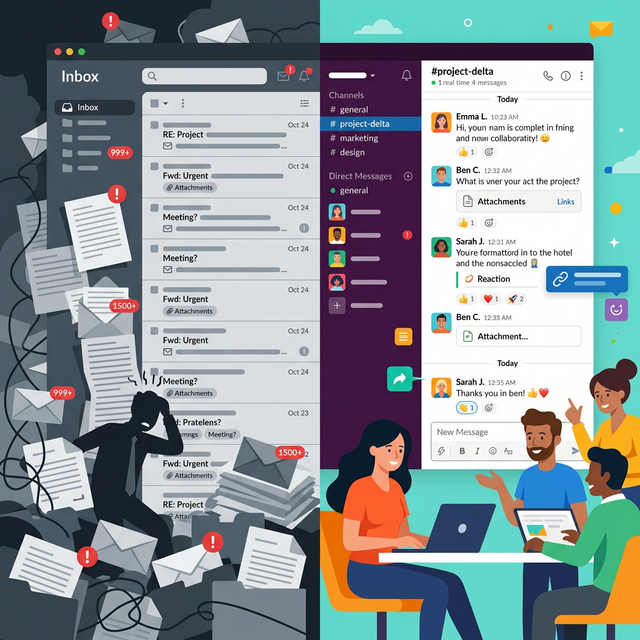
Email was designed to replace the postal letter — a one-to-one, asynchronous message between two people. It was not designed for a team of six people to coordinate a response to an angry enterprise customer while simultaneously tracking three other open threads.
Yet here we are. Most small and mid-sized teams run their entire customer support operation from a shared inbox, and most of them feel the friction every single day.
The shared inbox trap
On the surface, a shared inbox seems efficient. Everyone can see incoming mail. Anyone can reply. But the cracks appear quickly.
No visibility into who’s handling what. Without assignment, conversations fall through the cracks. Two teammates reply to the same email. Or nobody does, because everyone assumed someone else already did.
No context for the responder. When a customer emails in with a billing issue, whoever picks it up has to dig through their inbox history, check the CRM, maybe ping a colleague in a separate Slack or Discord message — and only then can they actually respond.
No way to escalate cleanly. “Hey, can someone look at this?” gets forwarded, CC’d, or BCC’d to a colleague. Now there are multiple threads, multiple inboxes, and zero clarity on who’s responsible.
Response time suffers. When your team has to context-switch between their inbox and Slack or Discord every time they want to collaborate, they default to one or the other — and emails wait longer.
What Slack (and Discord) actually give you
When support conversations live in a channel, collaboration becomes natural. Your team is already in Slack or Discord. They already have the muscle memory. They use reactions, threads, and mentions throughout their day.
Moving support emails there means:
- A teammate can jump in with context without hijacking the primary response
- Your engineering lead can be tagged when a bug report comes in, without needing a forwarded email chain
- You get a searchable history of every support interaction, visible to the entire team
- Urgency is immediate — a message in a channel feels different from an email buried in a shared folder
It’s the difference between support that happens in the open and support that happens in the dark.
The missing bridge
The obvious objection: customers don’t email your Slack channel. They email support@yourcompany.com.
That’s the gap MailBridge closes. Every email that hits your inbound address is triaged, categorized, and posted into the right Slack or Discord channel — formatted for readability, with the full context your team needs to respond immediately.
Your customers still send email. Your team works in Slack or Discord. Neither side has to change their behavior.
What teams actually gain
Teams that make the switch typically see a few things happen:
Faster first response. When a support request arrives as a Slack or Discord message, it sits in a channel your team is already watching. There’s no separate tab to check, no morning inbox triage ritual.
Better accountability. Channel threads make it obvious who responded, who didn’t, and what was said. There’s no inbox to hide in.
Easier escalation. Need engineering? Tag them. Need your billing team? They’re right there. No email forwarding chains, no “can someone look at this?” Slack messages running parallel to the email thread.
Less duplicated effort. When everyone can see what’s happening in the channel, two people don’t answer the same email.
The inbox isn’t going anywhere
This isn’t an argument to abandon email. Email is still how most customers reach out, and that’s unlikely to change. The argument is simpler: your team shouldn’t have to live in the inbox to support those customers.
The inbox is for receiving. Slack and Discord are for responding, collaborating, and resolving. The two can coexist — you just need something to connect them.